
Energy Purgatory: SoCal

By: Chris Amstutz

The recent pricing spikes in California serve as an interesting case study in the energy community. A series of events have aligned in California to give the CAISO grid and SoCal gas system their biggest test in the last ten plus years.  It certainly feels like Murphy’s law is at work in Southern California, and this has left analysts wondering if there could be anything else that could go wrong (hint: there always is). California is now entering a time of energy purgatory. The previously optimistic market analysts have suffered financially and now must atone for their mistakes. So what has made the situation so extreme? Will the conditions continue? And what are the ongoing trends affecting California energy markets? While these questions fall partially upon the agnostic gods of energy, the ultimate implication is whether California will return to the paradise of low prices, or if it will fall further toward a metaphorically and slightly-literal hellscape.

Natural Gas

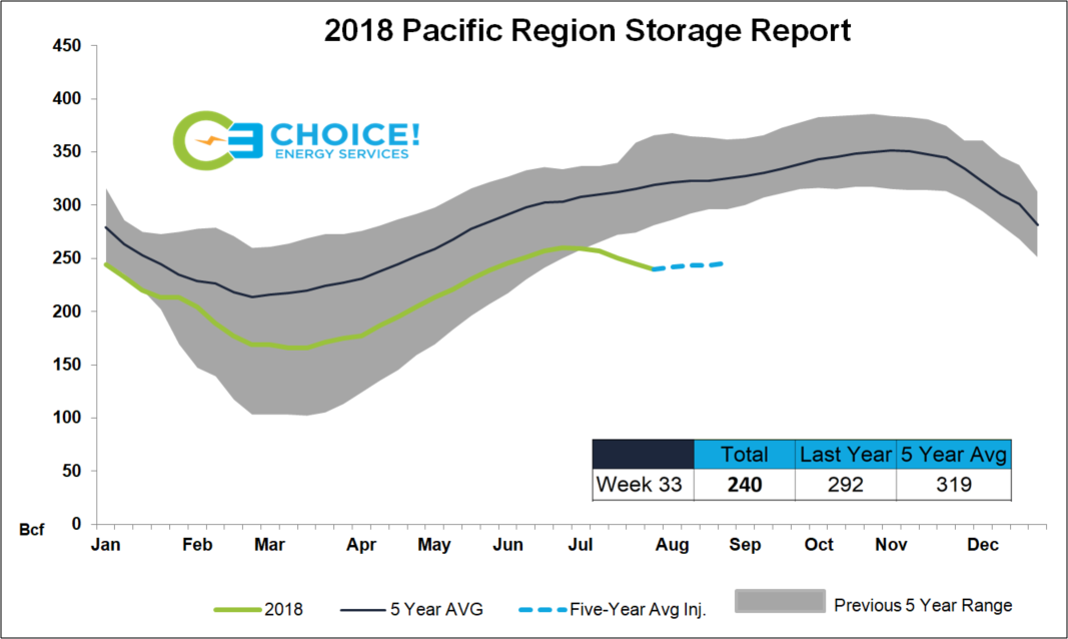
On July 24th, the SoCal Citygate daily average settled at $39.53/MMBtu, adding something else to the list of things for Californians to complain to their city councils about.  To give perspective, SoCal Citygate averaged $3.20/MMBtu in June-July of 2017, and NYMEX was trading at $2.73/MMBtu that same day. The record high sustained heat led to July being the warmest on record in California. The heat is surely the top culprit for increased daily prices, but this doesn’t nearly sum up the SoCal Gas story. When we look at the entirety of the gas transportation system, we see pipeline capacity restrictions of about 50% in the North and South zones entering the region. This indefinite, limited pipeline capacity becomes especially concerning when you factor in the gas storage situation in not only Southern California but the Pacific region as a whole. The Aliso Canyon storage facility in Los Angeles has just been approved to increase its’ storage capacity to 40% of total capacity, after its ongoing troubles with a leak. Supply constraints and low storage means we could begin to see serious pricing issues in the winter, when Southern California burns the most gas. The long term fundamentals have pushed futures prices higher with the SoCal Border Calendar 2019 strip now at NYMEX minus (-) $0.14/MMBtu, up $0.51 since late April. However, this is still down off of the high on 8/6 when the ’19 strip actually settled at NYMEX plus (+) $0.025. The Calendar 2020 strip is up 20 cents in the same time period. With all of this news, we are setting up for a situation where a moderate fall and warm winter can be the only savior for the region.
Power

On July 24th we saw the daily SP-15 hub price hit an all time high of $377/MW. This represented the peak of pricing during the extended “heat dome” weather period. The extreme heat brought a curtailment notice from SoCal gas to generators in CAISO. This was then passed on in a ‘flex alert’ curtailment notice (not a SoCal body building term) to power consumers. The fundamentals affecting the power market have not been favorable this summer. Certainly the issues with gas supply discussed above play in to this, but we have also seen hydroelectric outputs 30% lower than last year. California has also retired 6 GW of reliable coal/gas fired generation in the last 4 years. This means that solar and wind power have had to take the place of this lost generation, and these resources are inherently more volatile due to their dependence on weather. BUT WAIT THERE’S MORE… we have also seen a highly active year for wildfires (25% above five-year average) in California (reference the “slightly literal hellscape” quote above). Wildfires impact the transmission of electricity into regions, causing increased congestion on lines, even on days when there is adequate generation to meet demand. The futures market has reacted, with the SP-15 Calendar 2019 strip now at $42/MW, up $10 from February. The 2020 strip is up $5 in the same period.

So is the implication that California energy prices are damned for eternity? Obviously not, but the recent run up sits fresh on the mind of traders and analysts. The California market has always had an air of uncertainty to it, but until recently there has not been a pricing premium in the futures markets. This recent panic has burned (no pun intended) a lot of people who had been profiting on rolling the dice month to month during normal market conditions. The threat of what we have seen this year has been known for almost a year and those that diligently locked in their prices beforehand will now profit.  While this may be the current trend, there are already rumors about the California government intervening (surprise, surprise) to keep things like this from happening again, which could potentially push prices lower. Regardless, the gods of energy prices always favor the informed, and Choice Energy Services is here to help keep their light shining favorably (financially) upon your business.

Confidential: Choice Energy Services Retail, LP.


ERCOT Madness

By: Chris Amstutz

It’s that wild time of the year when work productivity tanks as people across America secretly watch their favorite college basketball team compete for glory in the NCAA Tournament. This sacred month for sports fans will be a roller coaster of expectations and emotions, just like this summer will be in the Texas power market. Price volatility has returned for the Electric Reliability Council of Texas (ERCOT). This summer represents uncharted waters for the ERCOT markets and will have implications affecting future summer pricing in Texas. Just as every NCAA Tournament has a unique cast of teams, this years’ Texas power market has a unique set of factors that are lending themselves to the madness. Let’s meet the teams vying for the right to call themselves the #1 price setting input:


#1 Seed: Power Reserve Margin

Team Bio: The difference between the expected peak power demand and total generation capacity (supply)

Resume: The recommended reserve margin is 13.75% but has fallen to 9.3% this year, strengthening its impact as a price influencer. The retirement of 4.2 gigawatts of coal-fired power announced in 2017 and delayed completion of natural gas and wind power projects has allowed for increased concern.

Intangibles:  Has the ability to make traders worry, without factoring in any other price influencers.

#2 Seed: Natural Gas

Team Bio: The NYMEX natural gas market price

Resume: The ERCOT market has traditionally been highly correlated to the NYMEX. The r-squared (direct correlation) between ERCOT Houston and NYMEX natural gas has been as high as 96% for a 90 day trading period. Natural gas prices have been falling which should lower ERCOT pricing.

Intangibles: An easy market indicator to watch. Natural gas pricing panics can influence the ERCOT market quickly.

#3 Seed: Weather

Team Bio: Drought conditions and short-term weather

Resume: The team that shows up to the tournament with the most potential to influence price, but could just as easily not show up at all. Texas summers are notoriously hot and cooling demand puts a huge strain on the ERCOT grid. Early drought conditions are fair and meteorologists are currently not concerned with long range summer forecasts.

Intangibles: The weather is a factor that can either become a huge problem during the tournament (summer), or it can quickly relax pricing tension. The weather is the main influence for short term price volatility.

 #4 Seed: Regulators

Team Bio: The Public Utilities Commission of Texas (PUC)

Resume: Intense debate between PUC members has arisen about what could/should happen this summer. These appointed officials are debating whether upward pricing spikes this summer balance the good of incentivizing utility investment with the bad of higher consumer prices. Their laws carry heavy market influence, but consensus seems to be that the market should be left alone heading in to the summer.

Intangibles: The ability to suggest laws regarding power prices can increase power pricing volatility on just talk alone

Results:

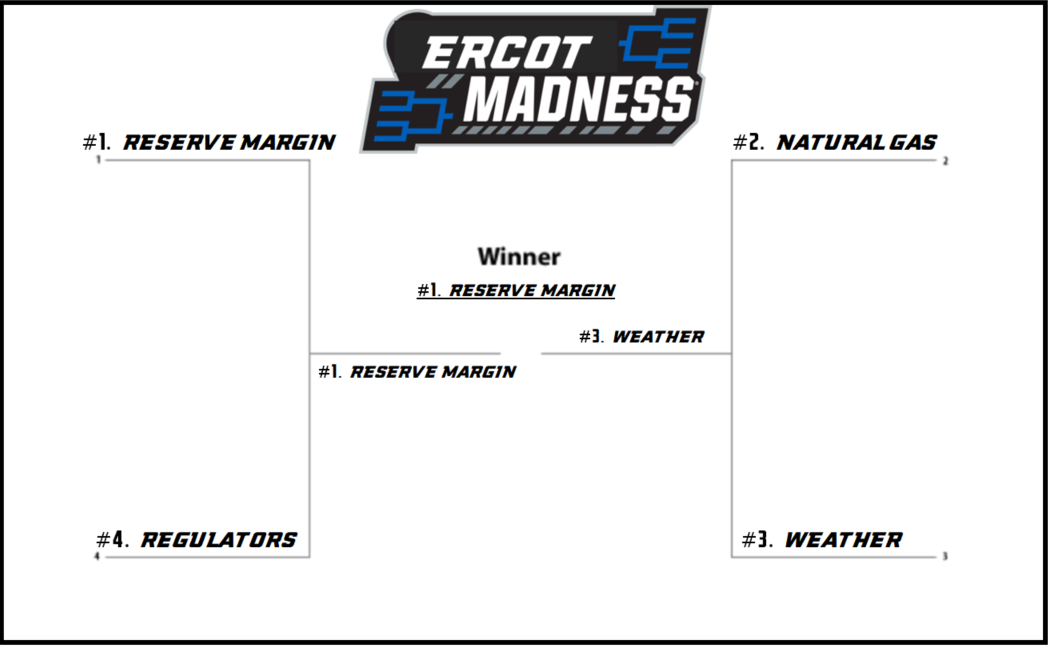
As you can see from the tournament bracket above, Choice Energy Services believes that the reserve margin will be the top influence on ERCOT prices this summer. Sure we picked “the #1 seed favorite” and while that may not always be the right move for your NCAA bracket, this is a clear choice. Prices have remained elevated in ERCOT since the announcement of coal generation retirements in October and fears have worsened since with the delay of wind/gas generation projects. The “regulators” in the PUC in Texas can do very little at this point in the year to try to help the 2018 ERCOT pricing situation, and all signs are pointing to a laissez-faire attitude from the committee. We have seen NYMEX natural gas prices fall in the last few months with the national influence of increased supply from the Marcellus/Utica region. Historically, this should have negatively affected ERCOT prices, but instead prices have risen. We still expect natural gas (and its falling futures prices) to have a long term bearish impact on ERCOT prices but it won’t be for this summer at least. The weather is a tough influencer to analyze. It could certainly have a huge influence on price this summer but we are not seeing clear enough signs yet. Texas just came off a historically normal winter and had near normal amounts of rainfall, despite contradicting La Niña conditions. We will get a much better picture of this summers’ weather the closer we get to summer, but there is too much volatility risk either way to try to hedge the weathers’ influence. As witnessed with the NCAA Tournament every year, picking winners and losers in a bracket is never easy. You can gather all the information and trends, like the analysts at Choice Energy Services, or you can pick teams based on their school mascot. Either way, you can rest easy during this fun time of year knowing we have your best energy interests at heart.

(Monmouth University bench circa 2016)

What Happened…A Market Review

By: Chris Amstutz

Last fall we witnessed Donald Trump accomplish the improbable by defeating Hillary Clinton in the US Presidential Election. This fall we have seen a surge in Texas power futures, and many are again left wondering, what happened? While the results of a US Presidential Election may be moderately more important (sarcasm), I assure you that such volatility in the top power consuming state should hardly go unaddressed.

First, we can address the outcome. Without any influence from the “rigged” Electoral College, Houston Hub Calendar 2018 On Peak pricing has risen.. big league. It is currently up 14.5% from the yearly low of $35.47 on July 24th to a two-year high of $40.64 on November 14th. The North Hub 2018 strip is up 26% in the same time period. The spike in these strips’ pricing has been brought on by huge premiums for the summer months. Houston Hub July and August prices are up 57.7% and 38.5% since the start of October trading. Either Texans are preparing their power-hungry Air Conditioners for a summer visit from the Heat Miser (Happy Holidays), or there are other factors at play here.

Plausible explanations for the spike are abundant. Is the rise in the calendar 2018 strip pricing yet another populist movement spurred on by the slogan of “Make Texas Great Again”? No, but parallels can be made to the election in that there is A LOT of uncertainty going forward for power prices in Texas. The first uncertainty is how bad the effects of this winters’ La Nina could be. La Nina typically brings warmer drier weather to Texas, and this could put a strain on the ERCOT grid come summer. Russian’s hacking our grid always has the potential to affect power prices, but the reality is that this rally has been brought on by scenarios that result in rolling black outs in Texas (insert alcohol consumption joke here). The expected 2018 summer generation reserve margin for ERCOT has dropped 2-3% below the targeted goal of 13.75%, due to recent coal-fired power plant closures. Texas is expected to shutter 5.1 Giga Watts worth of coal powered generation by early 2018. This generation is being replaced by wind energy, which could be problematic when there are windless high temperature days across the state. Yes, it would take near record temperatures, drought and a lack of wind generation to create this worst case scenario, but the market is pricing the possibility.

If there is anything to be learned from the 2016 Presidential Election, it is to never underestimate a risk. The ERCOT market has been presented with a plausible scenario that would skyrocket prices. For this reason, uncertainty will keep the price high. Upcoming decisions on coal plants will lessen the uncertainty but for now we are in a wait and see situation.

**The analysts at Choice Energy Services are equal opportunity political comics

Confidential: Choice Energy Services Retail, LP.