ERCOT Disaster: MythBusters

By: Chris Amstutz

The winter storm of the century in the energy capital of the world has frozen all preconceived notions of the Electric “Reliability” Council of Texas. As the snow melts and the plumbing repairs begin, the analysts at Choice! Energy Management find solace in aiding Texans through these difficult times. With any natural disaster, people want answers and to know how their interests will be protected in the future. This has given way to the blame game and many myths about the Texas power market. To help address these questions we look back to the long running, scientific TV series MythBusters. The causes of the ERCOT disaster are innumerable and it is with an open mind that we dissect the situation.

Myth (noun): A widely held belief not factually proven; an exaggerated or idealized conception.

Myth #1: “ERCOT should have been able to prevent the power outages with the 7 day notice they had of the impending weather event.”

Answer: Busted

This disaster has shown the weaknesses of the ERCOT grid, especially in the winter. Generation assets in Texas did not have the infrastructure upgrades to prevent malfunction during the cold, known as winterization, and this is likely the main reason for failure last week. Winterization was an expense spared by generators since a deep freeze does not occur often, helping Texans to enjoy lower power prices. Like the Titanic heading for the Iceberg (see the MythBusters confirm that Jack could’ve survived with Rose here), the 7 day forecast was not enough time to prepare the grid.  ERCOT operates under the assumption of a ten-year normal winter (which will certainly change now), and this event was likely a one-hundred-year event.

Myth #2: “One single energy generation source (renewable, fossil fuel, or nuclear) was to blame for the blackouts.”

Answer: Busted

This popular political talking point (everything is political these days), has been thrown around a lot. To this we point to the graphic below. Yes, the wind turbines were frozen and yes, natural gas and coal did have the largest absolute decreases in generation available, but pointing to half the truth is not the truth. In all reality, the frozen precipitation had huge impacts on every generation source. From pre-freeze levels, it is estimated that natural gas lost 15-20 Gigawatts (GW’s) of generation, not including the 15 GW’s that were offline for seasonal maintenance. Wind Generation fell from 5-10 GW’s pre-freeze to 1-2 GW’s during. Coal lost 6 GW’s during the freeze, and even the incredibly steady nuclear baseload lost 25% (1.3 GW’s) due to the fear of insufficient water supplies. Future ERCOT conversations will now involve adequate winterization, and a repricing of all assets not protected from winter weather and sufficient reliability.

Myth #3: “This was a black swan weather event so the chances that prices get this crazy again are tiny.”

Answer: Busted

A black swan event is defined as something “unpredictable” but this weather event has occurred before in ERCOT. The Christmas cold of 1989 was the most similar event to this, with colder absolute temperatures but not lasting as long. The grid also came close to blackouts in the 2011 cold event. When you also look at demand side issues, like the fact that Texas has added 1.5 million homes since 2011 (the most of any state by 600k homes), and 62% of these homes require electricity for heating, it compounds the issue. We have discussed power market volatility in our past blogs here, here, and here. With less reliable, non-winterized generation on the grid, ERCOT will remain susceptible to price spikes, and higher futures prices will be needed to steady the market.

Myth #4: “Forces outside of Texas wanted the blackouts to occur, and sabotaged Texans in some form.”

Answer: Busted

While not a widespread myth we have seen this claim thrown around. There is no reason to believe at this time that willful negligence or any other human induced action in the short time leading up to and during the event caused the power outages. From fake snow conspiracies (see here), to rumors of Department of Energy sabotages, there has not been any evidence of at this time. It is true that several members of the ERCOT board (including the now former chairman) reside out of state, but as of today all of these members have resigned due to criticism.

The last two weeks have certainly been difficult. Consumers are very much justified in demanding that reliability of the grid is prioritized to prevent an event like this from happening again. However, everyone is quick to forget the enormous amount of savings the ERCOT market structure has provided Texas in past years. The critics of the free-market ERCOT system are now louder than ever, and the future of this system is unknown. Opportunity will favor the informed, as the implications shake out from this event. The analysts at Choice! Energy Management take pride in helping our clients prepare, and look forward to helping more Texans navigate this ever-changing energy world.

The Energy Wizards of Oz: Trump & Biden 2020

By: Chris Amstutz

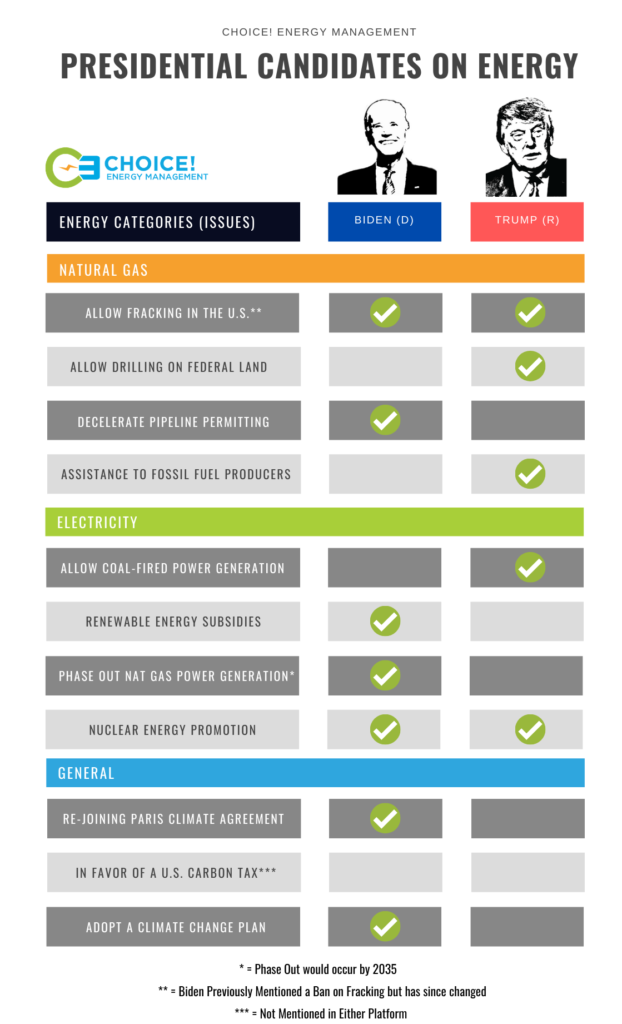
Never have we had Presidential candidates with such diametrically opposed energy policies. We have spoken in previous blogs about the intertwined climate/energy policy debate, and now we have been led up to the fork in the proverbial yellow brick road. Will we get behind the Tinman, Joe Biden, and grease the gears of a “green energy revolution”? Or will we continue down the path of the Lion, Donald Trump. In this blog we strive to reveal the men behind the curtain, and discuss potential implications for a few frequently discussed policies.

Drilling/Pipelines

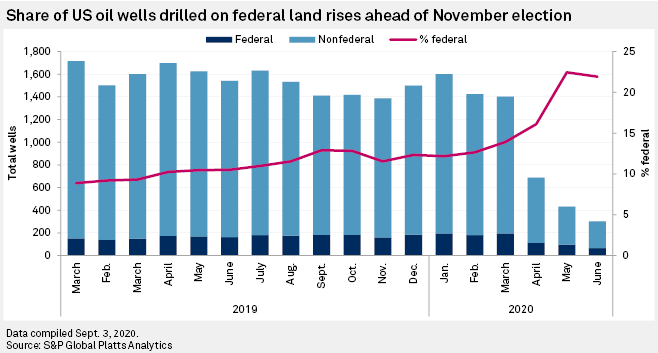
The first part of the climate/energy debate focuses on the extraction of fossil fuels and their subsequent movement across the United States. In the last 8 years, the U.S. has grown to be arguably THE energy superpower of the world through an innovation in drilling, notoriously known as hydraulic fracturing (fracking). Oil and Natural Gas production has risen dramatically and has seemingly only been capped by the ability to physically move the commodities on pipelines. Policies being proposed would aim at hindering new drilling, either completely or more likely on federal lands. This, coupled with a more stringent and selective review of new pipelines, would likely slow the growth of fossil fuels and increase the future price of natural gas.  Both candidates have made it known that natural gas will remain an important part of our energy mix, but to what extent the commodity could be slowed in the next 4 years will depend upon the election.

Green Energy/Power

The toughest part of the journey to the emerald green city of the imagined US energy future, will be in the power sector. Proposals in this election call for carbon free power generation by 2035. Like a tornado across Kansas, this would shake up our generation fuel mix, currently 40% natural gas, 20% coal, 20% nuclear, 8% hydroelectric, and 12% from wind, solar, geothermal.

  • As we mentioned in past blogs, Nuclear Power Parts 1 & 2, this fuel source is considered carbon free, but draws its own criticism. Neither candidate has come out enthusiastically supporting expanded nuclear energy, but they have been open to it.
  • It has been proposed that natural gas generation be used as a bridge fuel source as we phase out coal power and build out renewable sources. This path to a carbon-free power sector would financially strand (end before costs are recovered) 100-300 billion dollars in fossil fuel generation assets (coal and natural gas).  The labor and capital needed to build enough wind and solar generation with needed battery backup systems, would be on the order of 10+ trillion dollars in government/private investment.

Any new, unplanned costs would likely be passed on to businesses and consumers or levied through a federal tax, potentially on carbon. While these dollar estimates do not factor in the hidden costs/benefits of the health of citizens and the climate, these are the known real numbers for a structural energy change. Good, bad, or indifferent, a path towards a green energy future could begin after the election.

Source: Wood Mackenzie

General Attitudes

Regardless of your preferred or projected outcome for energy policy in the US, it is no secret that this is an important election for the industry. Certain policies being proposed are further left politically, but it takes support from the scarecrow, tinman, and lion (all branches of the government) to enact policy change. This could delay or even fully prevent new policy from being enacted.  Donald Trump and the Republicans have been more supportive of the fossil fuel industry through word and action. Joe Biden and the Democrats aim to start the process of change in the industry to save the climate. Naturally, change brings volatility and unplanned costs in complex markets. Morality and politics of the issues aside, Choice! Energy Management will be here as the Good Witch of the North, monitoring and guiding clients through sound Risk Management involvement.

via GIPHY

Choice! Energy Management takes no political stance towards any energy policy discussed. The goal of this blog is to present, without bias, energy policy positions of each candidate in a light-hearted and informative manor.

Confidential: Choice Energy Services Retail, LP.

Nuclear Power: The Half-Life of an Industry

By: Chris Amstutz

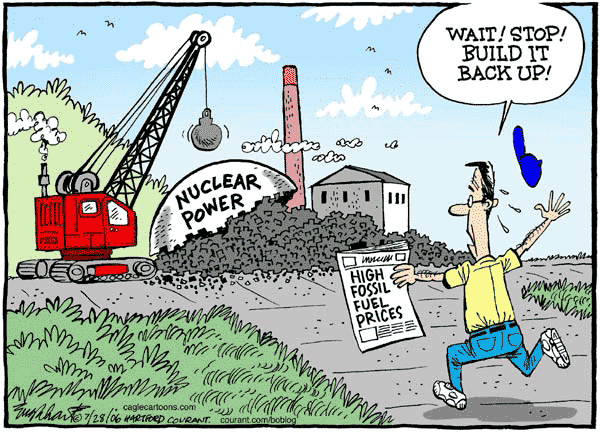
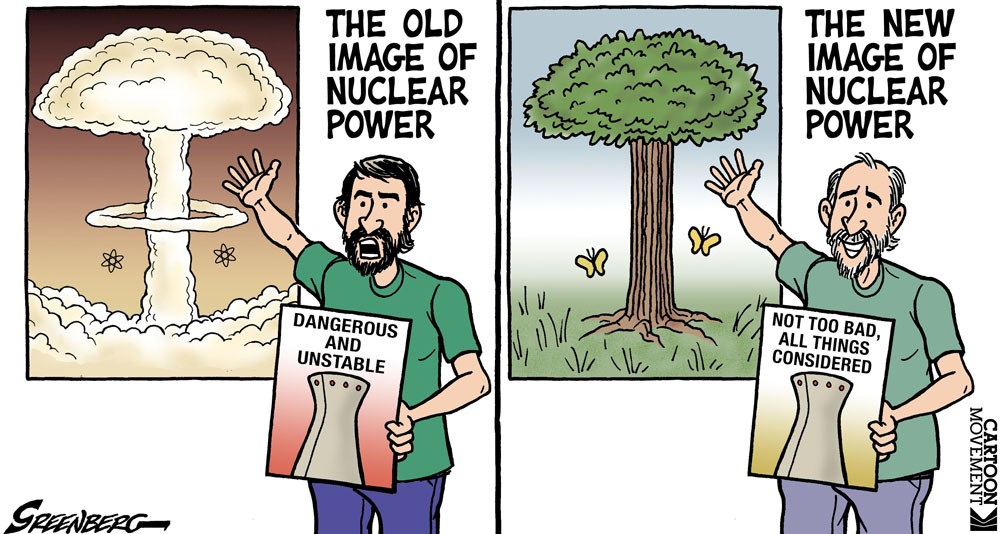
What images come to mind when you hear the term “Nuclear Power”?  If it is 3 eyed fish, rivers of fluorescent glowing matter or people in haz-mat suits, you aren’t too far off from most people.  Shows like The Simpsons have been painting a satirically negative view of the nuclear industry for decades and environmental groups are quick to join the bandwagon.  Nuclear power makes up 20% of the United States’ electricity generation, but is often only discussed when something catastrophic happens.  Is Nuclear power dying out and what are the implications? The Choice Analysts are always watching for interesting new developments in the energy markets and the recent news out of Georgia has us questioning the role of nuclear-powered electricity generation in the United States and its’ potential future.

We reported on nuclear power in the July 2017 Bulls and Bears Report and the section was titled “The Death of Nuclear” (harsh, we know).  Since that time, little has changed in the outlook for the nuclear power industry except a late December ruling from utility regulators in Georgia.  The decision is an approval for the Georgia Power utility to finish the two, long-delayed nuclear reactors that have already cost the rate payers of Georgia billions of dollars.  The impact of this decision is being called a lifeline for nuclear power. The decision was made under much controversy but is emphasized as the right choice by regulators, given the context of the project.  Regulators cited the fact that despite the hefty upfront costs, current nuclear reactors have outperformed the projected cost benefit in Georgia.

The main argument against construction of new reactors is that the power takes decades to show a favorable return on investment, versus natural gas at current fuel costs.  Heavily simplifying the math of the scenario, it is estimated that a nuclear reactor could have over 10 times more fixed costs than a natural gas fired plant, but once finished, Nuclear power could save over 20% on fuel costs over its’ life time (For a deeper understanding here is another link).  The many moving projections are what make the future value calculations tricky, and even more so when factoring in social costs/benefits, like decreased CO2. The scenario in Georgia really boils down to the fact that Georgia Power made a conscious decision to continue an already troubled nuclear project, in the context of a rapidly evolving electricity generation environment.  This is a gutsy call and would need some market support to prove financially wise.

Does the US really need Nuclear energy?  Should we be improving nuclear tech and approving more sites?  These seem to be the billion dollar questions.  Almost all of the nuclear reactors in the US are nearing the end of their lives, so this question will have to be addressed in the coming decade.  If not nuclear power, alternatives would surely include increasing natural gas-fired power generation or some other sort of fossil fuel. (Insert environmentalist outrage here).  Another option would be increasing battery storage capacity to help promote renewable energy, though battery capacity technology is not advanced enough at this time to make this a solution at the macro grid-level.

Whether you love or hate Nuclear power, the facts still remain that it is a prevalent, non-carbon emitting, reliable and long term cheap source of energy.  It is examples like the decision in Georgia that remind us, that despite the overwhelming regulations and negative press, maybe Nuclear power isn’t dead yet. As energy market analysts, the watch (and wait) continues for changing perceptions and the ultimate fate of the nuclear power industry.

Confidential: Choice Energy Services Retail, LP.