LNG Windfall Winners – Not the Usual Suspects

By: Matthew Mattingly

https://giphy.com/gifs/snl-saturday-night-live-season-44-5bkpoGHpV6TePeyKFd

The ever-changing energy landscape has proven its prowess again with the recent evolution of Liquified Natural Gas (LNG) markets. Staying ahead of these trends requires a voracious reader willing to scour articles, blogs, and even Twitter. Books are slightly less of a requirement yet, I recently found myself reading Meghan L. O’Sullivan’s recent published book, Windfall. The book discusses in great detail the benefits that the fracking revolution (not my favorite expression) has had in the United States, and the domino effect it has had on the rest of the world. The globalization of gas markets through LNG has created winning countries and losing countries (including our shirtless Siberian friend), and the implications are numerous. This book reminded me of how much the U.S. natural gas market has changed in my 15 years in the industry. For these reasons, Choice! Energy Management closely tracks LNG metrics and provides monthly commentary on how news in far away lands can now affect Risk Management strategies for our clients.

Winner: China

Napoleon famously said “China is a sleeping giant. Let her sleep, for when she wakes, she will move the world.” China has awoken and is now a fierce dragon.  China’s growth in the 21st century is remarkable, with now the second largest GDP requiring large sums of fossil fuels that it does not possess within its borders.  The book Windfall discusses China’s initial “going out” strategy of investing in production in Latin American and African countries. In the meantime, China’s booming economy collided at a perfect time with the United States’ fracking boom, allowing for robust LNG imports. China now has access to the United States’ 12 BCF/Day of LNG capacity, when in previous times they suffered shortages. Demand has still outpaced supply in the LNG world, leading to prices of $12 – $20/MMBtu for China, compared to roughly $3/MMBtu in the U.S.  This cost will continue to fall as natural gas markets globalize bringing prices closer together.

Winner: Europe

Many European nations would prefer to move away from natural gas due to climate policies, but demand is still strong. Even as a “bridge fuel” to carbon neutral goals by 2050, the EU will be burning 550 billion cubic meters annually in 2021 through 2025.  Supply is heavily dependent on Russian imports (over 40% of Europe’s natural gas supply).  With such a strong reliance on Russia’s fossil fuels, European nations have been reluctant to fight Russia/Putin on policy conflicts (see Ukraine gas conflicts/cuts in 2006, 2009, and again in 2013). However, with a growing supply of LNG available, Europe has a new partner in the natural gas supply game. Europe can now diversify their natural gas imports, with the United States becoming a larger player. Windfall projects the United States to represent 18.9% of Europe’s gas imports by 2025. If nothing else, the additional LNG supply provides Europe negotiating ground against Russia, as recently seen with Nord Stream 2 pipeline.

Loser: Russia

To say Russia relies on fossil fuels would be understatement. Oil and natural gas account for more than 60% of Russia’s exports and provide more than 30% of the country’s GDP. The last thing the former Soviet Motherland wants is an oil and gas competition, but that is what it is getting thanks to the United States shale revolution.  In a similar fashion to the oil price collapse in 2014, U.S. LNG is gaining global market share, pushing prices lower. This is hindering Russia’s leverage on pipeline project negotiations like Nord Stream 2 to Europe and Power of Siberia to China. Additionally, it is causing delays in their own LNG export terminals (Valdivostok LNG Project). These pipeline and LNG projects are being reviewed as the financial benefits to Russia are not as strong, thanks to U.S. competition. 

Choice Energy Management – LNG Monthly Update

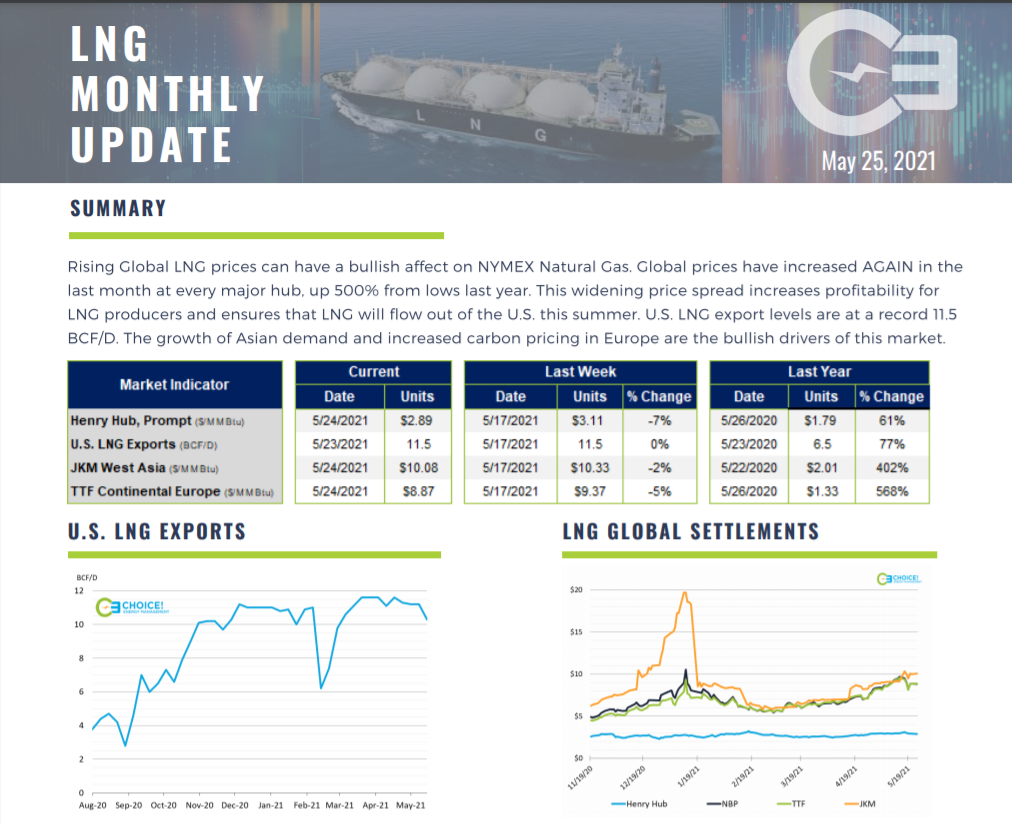
LNG exports have been a game changer for the U.S. natural gas market, and also for the rest of the world. This has not been lost on the team at Choice! Energy Management, as we have written about the topic for years. To highlight the growing trend, Choice! now provides a monthly LNG Report to its Risk Management clients, showing export levels, U.S. export terminals, and global hub prices. You can access the LNG Monthly Update here or talk to your consultant on how to gain access to the report.
Five Years and Fifty Blogs Later

Choice! Energy Management’s blog, The Burn, is an extensive and diverse selection of posts on all the latest energy news including technology, politics and business. Our goal is to open pathways for productive conversation, as well as examine Choice’s place in the world of energy.

Where has the time gone? Five years ago, Choice! Energy Management began publishing monthly blogs to help our clients, future clients, and anyone interested in energy market current events stay informed. We have written about things as small as how to read your commodity supply contract, to things as complex as global trade affecting domestic energy markets. Our light-hearted themes have ranged from Joe Dirt to Alex Trebek (may he rest in peace), crossing Sporting Events, TV Shows, Movies, and Music. As we look back on our first fifty blog posts, we reflect on the good, the funny and the outrageously accurate predictions.

The Good

Taking complex topics and boiling them down in to blogs is no easy task. Whether explaining complex market dynamics, or presenting new technologies in the field of energy services, our blogs strive to make things simpler. Below are two of our favorite blogs that we feel exemplify our succinct style.

DOMO ARIGATO, MR. ROBOTIC PROCESS AUTOMATION: In the theme of the classic Styx song, we present an in depth look at what sets our proprietary platform Choice! Data Connect apart from other energy invoice and data collection platforms.

ERCOT DISASTER: MYTHBUSTERS: We look to the popular 2000’s TV show MythBusters, for a way to analyze the ERCOT power market. We debunk divisive and untruthful myths in the immediate aftermath of Winter Storm Uri in Texas.

The Outrageously Accurate

The mission of The Burn is to start conversations in the energy world. We don’t often tip our hand on our market intelligence, but do like to point out fundamentals and trends that could ultimately affect energy market prices. Below are a couple of the blogs that panned out just the way we foretold.

STRANGE TIMES: NATURAL GAS STORAGE LEVEL: Published 10/16/2018, this Stranger Things themed blog highlighted the bullish market fundamentals that eventually led to the highest NYMEX natural gas prices we have seen in the last 7 years. NYMEX Prompt traded at $3.20/MMBtu at the time of this blog, and a month later skyrocketed to as high as $4.92/MMBtu.

ENERGY PURGATORY: SOCAL: Published on 8/22/2018, this blog came fresh off the Natural Gas and Power market chaos in Southern California at the time. We suggested hedging against “purgatory-like” price uncertainty in the region. Everything that can go wrong is still going wrong in this market, and prices continue to climb today. 

The Funny

Energy markets and energy industry services are not the most humorous topics to write about. Nevertheless, we persist, adding in what we perceive to be top shelf, grade A humor; chasing that dream of being the first energy consultants on Saturday Night Live. Read below and judge kindly.

STRATEGERY: An SNL skit themed dive into why Choice! is distinguished from the rest when it comes Strategic Procurement of Natural Gas and Electricity.

HOLIDAY MOVIES AS NATURAL GAS FUNDAMENTALS: A nostalgic Christmas blog comparing six classic movies to natural gas market fundamentals. The blog is informative for those who know nothing about energy markets.

We look forward to writing more energy market blogs in the future and appreciate you as an audience. Energy is a complex topic and as witnessed by recent blackouts and pipeline outages, it is growing in importance, deeply impacting our lives and businesses every day. It is our passion and mission at Choice! Energy Management to provide the knowledge and services necessary to keep your business doing what it does best. For more information on how we can best serve you, please reach out to a Choice! consultant today.

ERCOT Disaster: MythBusters

By: Chris Amstutz

The winter storm of the century in the energy capital of the world has frozen all preconceived notions of the Electric “Reliability” Council of Texas. As the snow melts and the plumbing repairs begin, the analysts at Choice! Energy Management find solace in aiding Texans through these difficult times. With any natural disaster, people want answers and to know how their interests will be protected in the future. This has given way to the blame game and many myths about the Texas power market. To help address these questions we look back to the long running, scientific TV series MythBusters. The causes of the ERCOT disaster are innumerable and it is with an open mind that we dissect the situation.

Myth (noun): A widely held belief not factually proven; an exaggerated or idealized conception.

Myth #1: “ERCOT should have been able to prevent the power outages with the 7 day notice they had of the impending weather event.”

Answer: Busted

This disaster has shown the weaknesses of the ERCOT grid, especially in the winter. Generation assets in Texas did not have the infrastructure upgrades to prevent malfunction during the cold, known as winterization, and this is likely the main reason for failure last week. Winterization was an expense spared by generators since a deep freeze does not occur often, helping Texans to enjoy lower power prices. Like the Titanic heading for the Iceberg (see the MythBusters confirm that Jack could’ve survived with Rose here), the 7 day forecast was not enough time to prepare the grid.  ERCOT operates under the assumption of a ten-year normal winter (which will certainly change now), and this event was likely a one-hundred-year event.

Myth #2: “One single energy generation source (renewable, fossil fuel, or nuclear) was to blame for the blackouts.”

Answer: Busted

This popular political talking point (everything is political these days), has been thrown around a lot. To this we point to the graphic below. Yes, the wind turbines were frozen and yes, natural gas and coal did have the largest absolute decreases in generation available, but pointing to half the truth is not the truth. In all reality, the frozen precipitation had huge impacts on every generation source. From pre-freeze levels, it is estimated that natural gas lost 15-20 Gigawatts (GW’s) of generation, not including the 15 GW’s that were offline for seasonal maintenance. Wind Generation fell from 5-10 GW’s pre-freeze to 1-2 GW’s during. Coal lost 6 GW’s during the freeze, and even the incredibly steady nuclear baseload lost 25% (1.3 GW’s) due to the fear of insufficient water supplies. Future ERCOT conversations will now involve adequate winterization, and a repricing of all assets not protected from winter weather and sufficient reliability.

Myth #3: “This was a black swan weather event so the chances that prices get this crazy again are tiny.”

Answer: Busted

A black swan event is defined as something “unpredictable” but this weather event has occurred before in ERCOT. The Christmas cold of 1989 was the most similar event to this, with colder absolute temperatures but not lasting as long. The grid also came close to blackouts in the 2011 cold event. When you also look at demand side issues, like the fact that Texas has added 1.5 million homes since 2011 (the most of any state by 600k homes), and 62% of these homes require electricity for heating, it compounds the issue. We have discussed power market volatility in our past blogs here, here, and here. With less reliable, non-winterized generation on the grid, ERCOT will remain susceptible to price spikes, and higher futures prices will be needed to steady the market.

Myth #4: “Forces outside of Texas wanted the blackouts to occur, and sabotaged Texans in some form.”

Answer: Busted

While not a widespread myth we have seen this claim thrown around. There is no reason to believe at this time that willful negligence or any other human induced action in the short time leading up to and during the event caused the power outages. From fake snow conspiracies (see here), to rumors of Department of Energy sabotages, there has not been any evidence of at this time. It is true that several members of the ERCOT board (including the now former chairman) reside out of state, but as of today all of these members have resigned due to criticism.

The last two weeks have certainly been difficult. Consumers are very much justified in demanding that reliability of the grid is prioritized to prevent an event like this from happening again. However, everyone is quick to forget the enormous amount of savings the ERCOT market structure has provided Texas in past years. The critics of the free-market ERCOT system are now louder than ever, and the future of this system is unknown. Opportunity will favor the informed, as the implications shake out from this event. The analysts at Choice! Energy Management take pride in helping our clients prepare, and look forward to helping more Texans navigate this ever-changing energy world.