Strange Times: Natural Gas Storage Level

By: Chris Amstutz

The fall season inherently breeds uncertainty. Questions like, will the weather be 80 degrees and sunny, or 50 and rainy? Should I pay money to have someone scare me, or just sit at home and let the evening news do it? Or the most important, troubling question of them all, will natural gas storage levels be at unsustainably low levels to start the winter? The natural gas market is experiencing strange times. We are seeing some fundamentals experience record highs, and some record lows. Whether you’re familiar with the hit Netflix drama Stranger Things or not, there is a similarity between the show’s eerie drama, and the market movements that are being spurred by low natural gas storage levels. The fall season is full of questions, but wondering if your business is protected from potentially volatile NYMEX price movements this winter should not be one of them.

Whether you long for the nostalgic 1980 time period of the show, or a storage inventory level over 4,000 BCF, our situation is grave to say the least. We currently sit at a storage level of 2,956 BCF. That is 607 BCF below the five-year average, and 627 BCF below last year. We started the injection season at 1,281 BCF in storage, but bearish sentiments were abounding at the time with production setting new records then, and nearly every week since (7-12 BCF/Day above the five year average). Unfortunately, several summer fundamentals, previously discussed in our Bulls and Bears Reports, made up that difference on the demand side, preventing the needed storage injections. Similar to Dart the underfed pollywog, we have only averaged a weekly injection of 81 BCF this year, as opposed to the five-year average of 82 BCF. The EIA expects the storage level to get up to 3,263 BCF (lowest level since 2005), but many projections are lower.
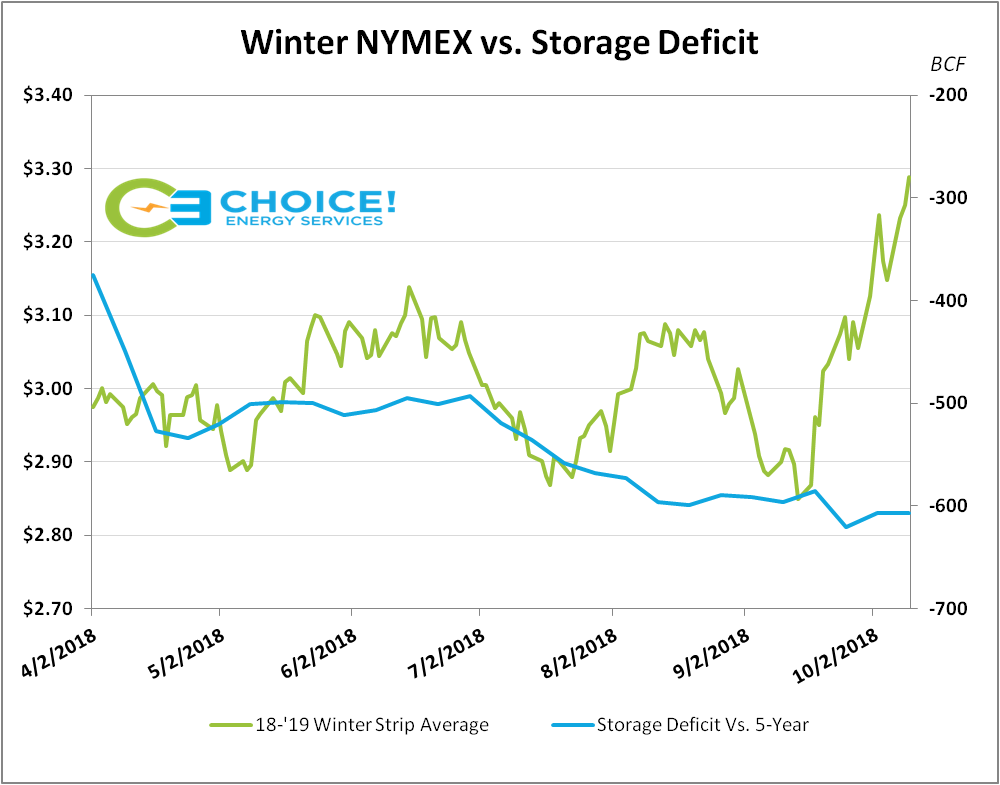
So what is the implication of the natural gas market being in the ‘Upside down’ world? In a word, volatility. For most of 2018 we have seen intraday prompt month trading ranges of 5-10 cents. This has now increased to 10-15 cent ranges, and could become larger the closer we get to winter. The NYMEX 2019 Calendar strip has increased $0.20/MMBtu in the last month, on concerns for this winter. Supply constricted areas such as the Northeast and West Coast may experience even larger swings, depending upon the weather. While there is always the chance for this situation to moderate in the coming weeks, the fear of the unknown is currently showing up as a premium in pricing for this winter.

This time of year does not have to be genuinely scary, especially for those dependent upon the natural gas market. Whether storage levels or production records are in control, the market fundamentals are always in flux, and it takes a trained analyst to see what’s coming next. With a flexible, comprehensive suite of energy management solutions, Choice Energy Services can help you keep the natural gas market demogorgons at bay.

Confidential: Choice Energy Services Retail, LP.


Check Back Soon Part II: Permian Production Growth

By: Chris Amstutz

Certainly by now our consistent blog readers are picking up on the theme of relating random pop-culture topics to energy markets, and maybe to your delightful chagrin, this blog will be no different. Today we will continue discussing our latest series on oil market volatility and how Permian production growth fits in to the puzzle. It is well documented that the oil market goes through cycles and this seemingly endless circle has wide reaching effects for other energy markets.  What better way to describe the cyclical nature of oil markets, than with a comparison to the classic American cinema trilogy Back to the Future. The repetitively witty script is based on the premise that humans don’t really change, just their time era and setting. In the recent months the market has again become favorable for another timeless American cycle: Oil drilling in the West Texas Permian basin. No DeLorean needed, as we frame the past and present situation before getting Back to (discussing) the Future outlook for the world’s hottest oil play.

BACK IT UP

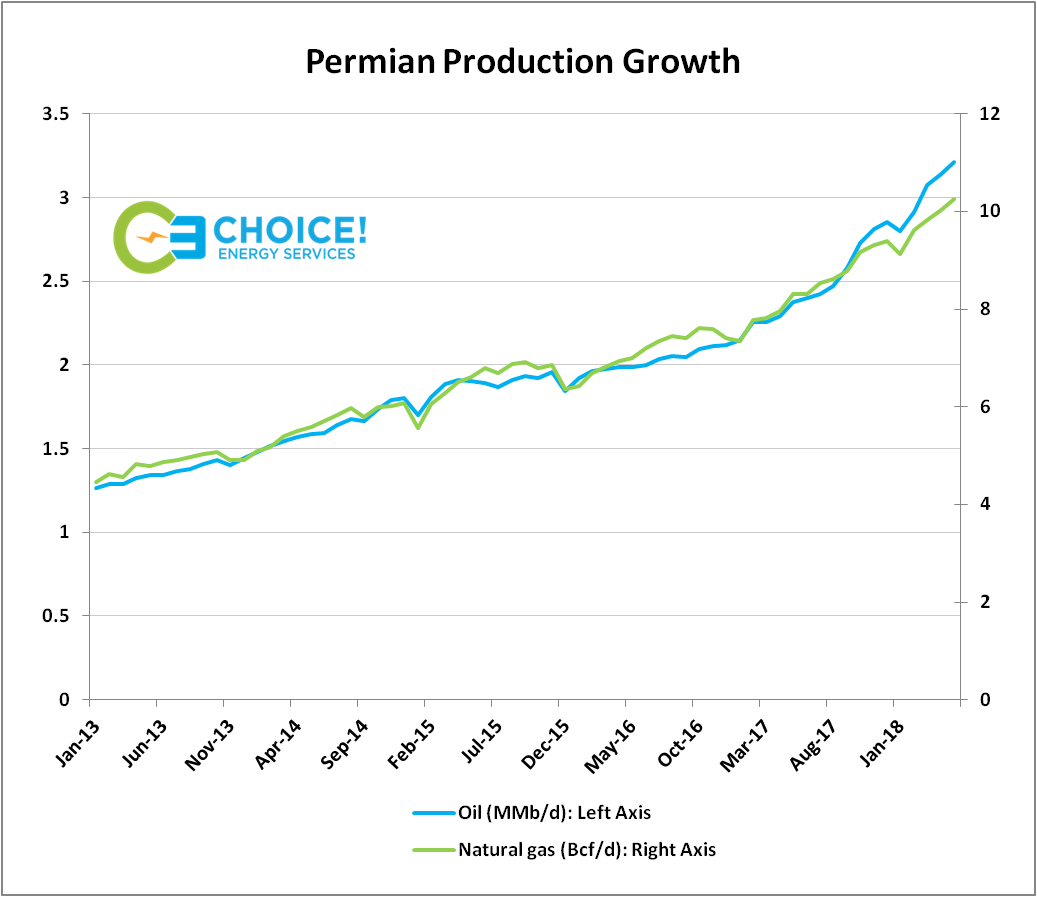
As discussed previously, the recent run up in Oil prices to the current mark of $75/bbl for Brent has caused increased attention and production in the Permian basin. Current output in the Permian is at 3.2 million barrels/day and the total output for the United States is expected to hit 11 million barrels/day by the end of 2018. This level of oil production has not been seen since the 1970’s to mid 1980’s (Back to the Future came out in theatres in 1985, coincidence… I think not). While many of the fundamentals have changed from that time period, the overarching theme of supply and demand affecting price and production are still what feed the cyclical oil markets today. Some analysts project production from the Permian to nearly double (~5 million b/d) in the coming years, which would make it the top producing basin in the world. This outlook has been made possible by a growing global demand for oil and a price level that supports American producers. The caveat to all of this positive news is that West Texas is experiencing intense growing pains. Pipelines out of the region for oil and natural gas have reached capacity and other methods of transportation must be explored. Regional demand has not grown fast enough and oil and gas is trading at a deep discount in West Texas. On April 23rd Waha hub gas traded at NYMEX (-) $1.40/MMBtu (half price) and the Midland oil hub to Cushing oil hub price differential is currently at a $9 discount. Can the region overcome its shortfalls in time before the next cyclical movement? Only Doc Brown and Choice Energy Services are worthy of a guess.

TO THE FUTURE

As long as the flying cars (and trains) that we were supposed to have by 2015 still use petroleum, the Permian can remain fruitful. Global demand for oil has topped 100 million b/d and is expected to grow every year by 1 million barrels/day.  The real question is how fast the region will be able to overcome the growing pains of transportation. The June issue of our Bulls and Bears report gave a more in depth analysis on the timeline of pipelines set to relieve the region. While producers have to wait at least 18 months for these new gas and oil pipelines to come online, shipping by rail and truck will account for most of the incremental takeaway capacity. It is estimated that an additional 40 thousand b/d could be transported by truck, and an additional 100 thousand b/d could be transported by rail.  This would still not be enough takeaway capacity, with the Permian averaging an increase of 70 thousand b/d, every month. Logistics aside, the region will be facing an oversupply situation and some analysts believe that the Midland oil hub to Cushing oil hub price differential could reach $20. This would certainly be a signal for production to slow, if global prices don’t send the signal before then. How Permian producers react and overcome this near term situation will affect oil market prices for years to come.

TIMELESS

The miraculous production growth in the Permian shale region has numerous implications for the oil markets, as well as other energy markets. The ability for American producers to export oil and influence its’ price on a global level carries tremendous geopolitical power. Additional natural gas recovered as an oil drilling by-product (associated gas), will continue to grow supply levels and keep domestic natural gas pricing depressed. The potentially positive influences from production growth in the Permian are numerous at this stage in the oil market cycle. So without the aid of a time machine, the analysts at Choice Energy Services will continue to monitor the fine details to better manage the risk of our clients.

Confidential: Choice Energy Services Retail, LP.
Did You See Those Prices?

By: Matthew Mattingly & Chris Amstutz

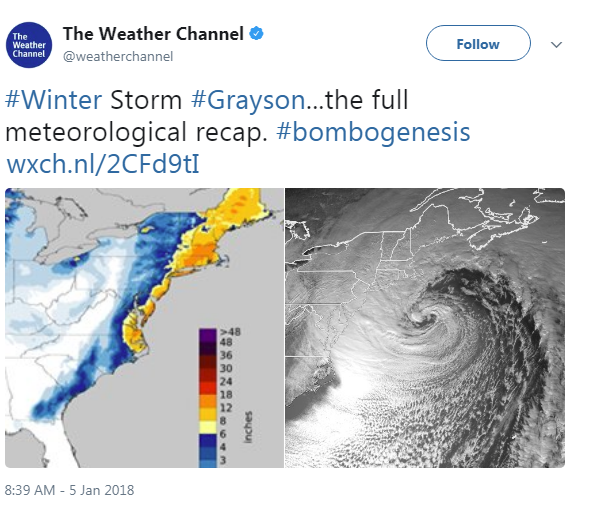
The Arcticgeddon, Snowmageddon, Bomb Cyclone Blizzard, or whatever you want to call it, just brought harsh winter weather to the Eastern Seaboard. This storm boasted 60+ mph blizzard winds and serves as the exclamation point for a wild two weeks of record low temperatures for the region and the eastern 2/3rds of the country. So how did it get to the point that the temperature in parts of the U.S. was colder than the surface of Mars? (Yes, it’s true). A number of factors (previously discussed in the Winter Forecasts (Not So) Set In Stone blog) including snow pack and blocking pressure systems have compounded to bring us this arctic chill.

Winter Storm Grayson is not just causing havoc to the people of the Northeast, but also to natural gas pricing. Gas daily pricing has been strong to start the year, but pricing for January 5th gas flow brought record numbers. Incremental daily pricing for last Friday’s gas flow even exceeding daily pricing during the Polar Vortex of 2014. Gas Daily Daily settlements for January 5, 2018 show the Algonquin pricing point at $79/MMBtu, Transco Zone 6 NNY at 125/MMBtu, and Transco Zone 6 NNY breaking $175/MMBtu. To put that in perspective, Transco Zone NNY averaged $3.22/MMBtu for the first 26 days of December 2017, a mere 3 weeks ago.

The recent high prices in the daily market once again highlights the lack of natural gas pipeline capacity entering the New York and New England market areas. Pipeline capacity in the United States has been discussed numerous times by Choice Energy Services via the Bulls & Bears reports, as it is such a crucial fundamental for local pricing. Although new greenfield and expansion pipeline projects have come online in 2017, and is expected to grow significantly in the coming years, they have not hit the New York and New England region. Pipeline projects have been met with fierce opposition from eco-minded politicians. While at the same time, the region’s demand for natural gas has grown significantly due to a large growth in the power sector.

This region is adjacent to one of the largest natural gas basins in the world but until new or expanded pipeline capacity is constructed, the pricing premiums are likely to occur again. As a result, end-users in the NY/NE area need to ensure they purchase their energy contracts strategically, while making sure they are mindful of incremental language in their natural gas and electricity contracts. Thankfully the clients of Choice Energy Services have peace of mind during this winter season, as their energy contracts were purchased prior to the winter season and incremental language was carefully evaluated to meet the risk tolerance of the clients.

Confidential: Choice Energy Services Retail, LP.