Git-R-Done vs Hurry-Up-and-Wait

by Rory Fabian

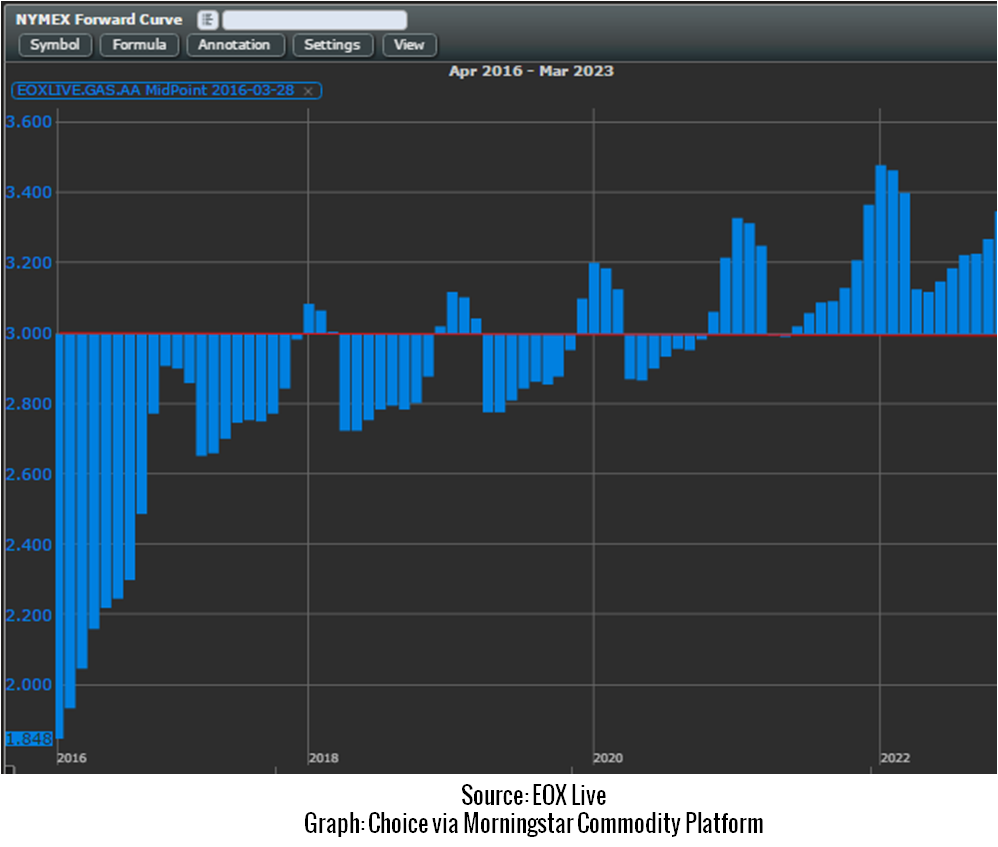
As if 2015 energy prices were not low enough, Q1 of 2016 has been defined by historic low energy pricing. Prompt month natural gas pricing has been trading below the $2.00/MMBtu mark since early February. The forward curve isn’t much better, as the NYMEX natural gas curve does not trade above $3.00/MMBtu till 2018! As Choice has discussed in other blog entries and white papers, the low pricing can be contributed to many factors such as: record production, STRONG storage levels, and bearish weather over the last couple of months. However, even with the low prices, for both prompt month gas and for the extended curve, reaction has been mixed by end-users. Many are excited about the opportunity and are locking up pricing for the long-term. Others are less than enthusiastic and are in no rush to secure their energy commodity price. Today, we will take a closer look at the two camps of clients – opposing mindsets – the “Git-R- Done” group and the “Hurry Up and Wait” crowd.
NYMEX Forward Curve


“Git-R-Done”

GitRDone

Prompt natural gas pricing is below $2.00/MMBtu and the rest of the curve is flatter than Rickie Fowler’s hat!  To put in perspective, the forward curve hasn’t been this low since you thought dial up internet was the greatest thing in the world (You Got Mail).  As a result, many end-users are locking their commodity prices now and locking it long-term. While there is a chance that pricing may go even lower, end-users in the “Git-R-Done” bucket are taking the risk off the table now instead of waiting to try find the bottom of the market.

The “Git-R-Done” group also realizes that pricing at these levels will not last forever. It didn’t take long for the market to rebound in 2012 when prompt month gas dropped below $2.00/MMBtu, and it could happen quickly again. Bullish movers such as natural gas exports (LNG and Mexico), declining rig counts, and a potential for a hot summer all have the ability to bring the supply/demand picture back in balance for natural gas. With end-users now seeing drastic savings over their previous energy contract, the “Git-R-Done” crowd wants to strike now.

“Hurry Up and Wait”
HurryUpandWait

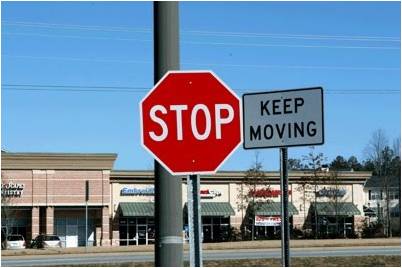
The second camp is the “Hurry Up and Wait” sector.  They are well aware that natural gas has been trading below $2.00/MMBtu since early February, but lower energy prices are becoming old news. They were told the prices in 2015 were low, when the market was consistently below $3.00/MMBtu and traded range bound the entire year. Pricing in 2016 has only dropped further from the “low” 2015 price levels so why should end-users lock now.

Additionally, there is no shortage of bearish news in the market. Storage levels are at record levels with the potential to break storage capacity levels at the end of injection season. Weather has been bearish all year with warmer than normal temperatures in the North, and mild temperatures in Texas. And even though the natural gas market is dealing with depleting rig counts and decreased associated gas from oil, production levels have remained at historic high levels.  Record production has been buoyed by an increased drilling efficiency, especially in the Marcellus Shale gas play. With so much bearish news-what’s the hurry?

Conclusion

What is the correct move here – “Hurry Up and Wait” or “Git-R-Done”?  It depends on the goal of the end-user. If the goal is to get the lowest price possible, then we will have to wait till the end of the year to see which group was correct in 2016. However, with many end-users (especially many of our clients) wanting budget certainty while obtaining contract over contract savings, the “Git-R-Done” crowd is gaining strong momentum.


Confidential: Choice Energy Services Retail, LP.

Say Goodbye to the Curve – Hats & NYMEX

by Matthew Mattingly

Typically at least once a day I will see something on the internet or TV that makes me feel old. Today didn’t disappoint when I saw the following tweet regarding hats….


dad hats


For the last couple of years I’ve noticed the trend was going to the flat bill hat, but curved hats are now called “dad hats?!”  What happened?  What’s wrong with society?  It didn’t seem that long ago when I was growing up that I used to make fun of other kids for not having the proper curve in their hat. Curving the bill of your hat was an art.  Make it too steep, and it looked like a mountain.  Curve the edges too much, and your hat would look like an odd geometry shape. The art was to ensure the curve was symmetrical and well rounded.  But I guess that art of curving your bill will be lost on the next generation just like CDs and flip phones.

Just like hats, the NYMEX natural gas market is trending more flat as well. The steep contango that once existed in the natural gas forward curve has shrunk dramatically to where premium is almost nonexistent in the forward curve. In fact, the February 16, 2016 NYMEX forward curve doesn’t print a $3.00/MMBtu price until January 2020! It wasn’t long ago when breaking below $3.00/MMBtu for prompt gas was an important technical threshold and considered a psychological hurdle for the natural gas market. Not any longer, every month for the next four years is trading less than $3.00/MMBtu.

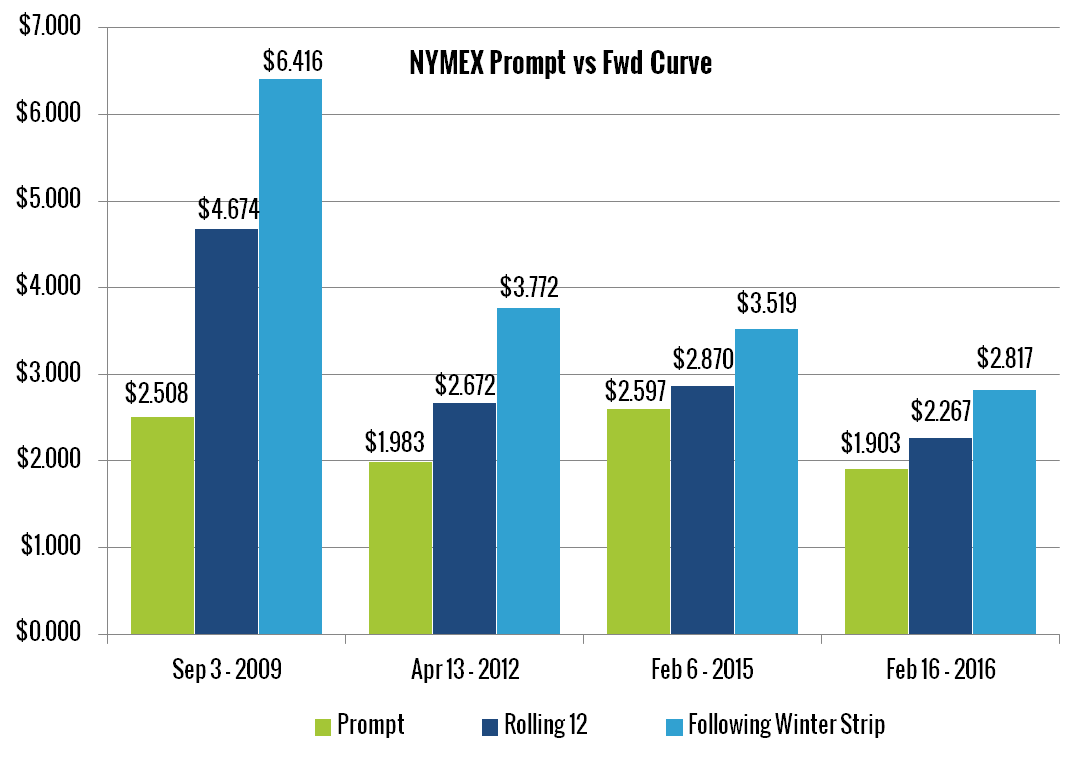
Breaking through the $3.00/MMBtu floor price has occurred a few times since the beginning of the shale revolution. When this did occur, producers found relief with the steep contango prices in the forward curve. For example, in September 2009 prompt month natural gas traded as low as $2.508/MMBtu but that was much lower than average for the next 12 months of trades ($4.674) and significantly lower than the trades for the following winter strip ($6.416). It took a few years for pricing to break the $3.00 floor again (spring of 2012), but when it did, producers could still count on pricing near $4.00/MMBtu in the following winter strip. Nevertheless, since that time the contango has continued to flatten to where it is today, with pricing less than $3.00/MMBtu across the board.

In time, most fashion trends are cyclical. So hopefully the curve brim hats will be back in style. Likewise, producers are hopeful for a return of higher pricing in the natural gas market. Producers are struggling at current price levels, and many will not have the capital to survive much longer. When will natural gas pricing return back to $3.00 or higher? That is tough to pin-point, but there are bullish signals to watch. But as of now, just like the flat bill hat, sub $3.00 pricing looks to be here to stay for some time.


nymex prompt


Confidential: Choice Energy Services Retail, LP.

Some NYMEX Trading Ranges are Wider than Others

by Matthew Mattingly

Let’s be honest with ourselves, 2015 was a boring year for natural gas trading. Once the bottom fell out of the NYMEX market at the beginning of the year, trading remained range bound for the majority of the year. Finally, when the natural gas market did experience some movement it was only further advancement to the downside. Prompt month gas broke through the $2.50/MMBtu support level and even traded below $2.00/MMBtu in December 15. This is a far contrast from 2014 that saw large movement in natural gas trading. However, will this continue in 2016?

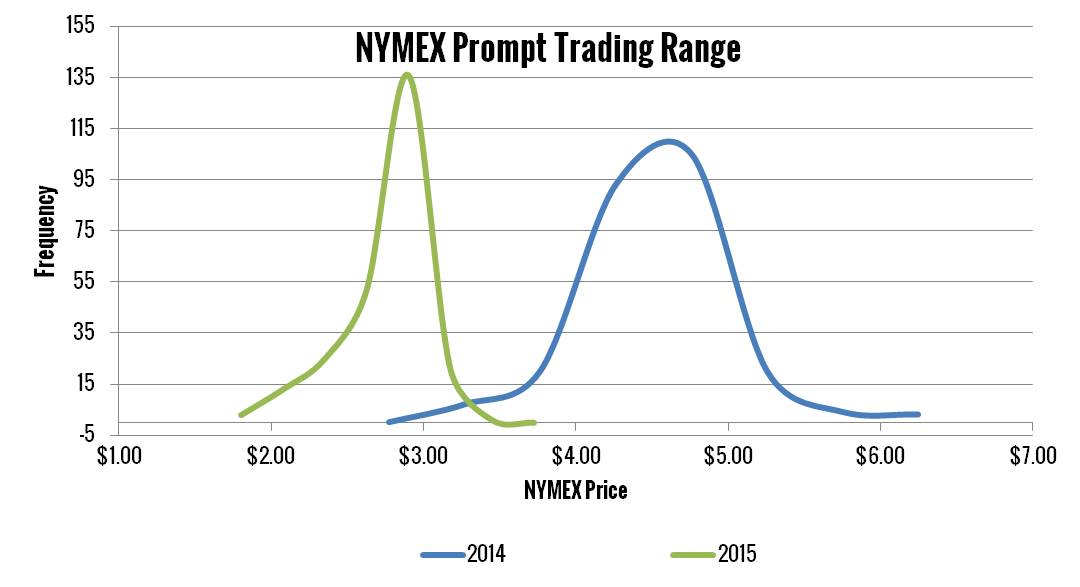
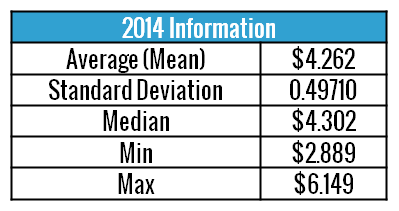
2014 natural gas trading was very volatile, mainly due to one factor: The Polar Vortex. The Polar Vortex has been discussed to death in the natural gas world, so I will not go into detail about the weather event. All one needs to know is that the Polar Vortex brought pipeline constraints (especially in the Northeast) and depletion of natural gas storage. In return, this led to elevated pricing in the natural gas market during the 2014 winter. Prompt month natural gas traded as high as $6.149 causing a wide range in pricing for the calendar year. The 2014 NYMEX stats and figures are listed below, but I will highlight the standard deviation in pricing was nearly $0.50/MMBtu for the calendar year.

2014info

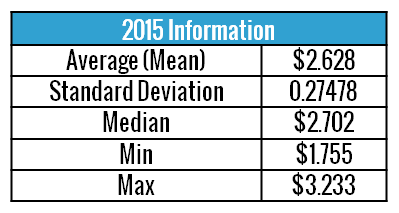
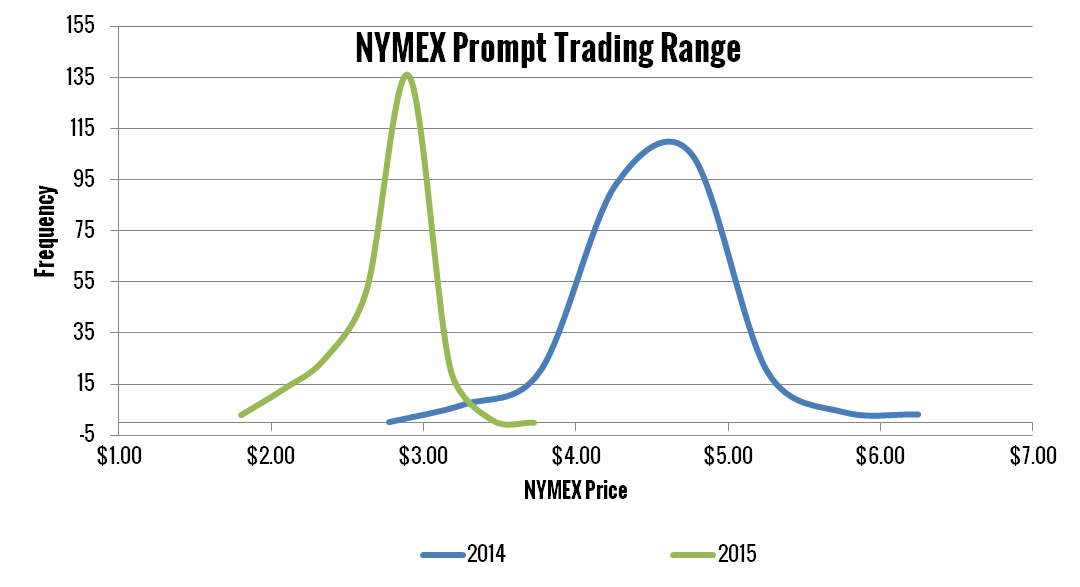
In contrast, 2015 was anything but volatile. As the stats and figures illulstrate below, that range and standard deviation was much smaller in 2015 for NYMEX promot trading. In fact, it took a further collapse in pricing at the end of the year to widen the incredibly tight range. The bell curve further highlights the differential between the two years showng the tight range and lower pricing in 2015.

2015info

So, what does this mean for 2016? 2016 is continuing the same trend from 2015 with trading remaining very range bound (January and February typically are volatile trading months in the natural gas market). A mild winter, strong production in the face of declining rig counts, and strong inventory levels have prevented any uptick in the market. This is good news for end-users who are taking advantage of the lower commodity pricing. However, it could also be giving end-users a false sense of comfort in regards to NYMEX pricing. End-users are becoming complacent and increasingly reluctant to secure pricing in the forward market, believing current conditions will be the norm. Staying focused on one’s clearly defined risk goals and objectives are important, preventing any false sense of security since the market will not remain this way forever. It may be in a few months, at the end of the year, or even next year, but in time the market will react to bullish factors and begin to rise.

2016graph


Confidential: Choice Energy Services Retail, LP.