Checkmate: Has Trump Slumped Oil?

By: Chris Amstutz

The holidays are a time for being thankful for family, friends, and the recent slump in oil prices. Obviously lower oil prices mean Americans save more on gasoline, but oil prices affect many aspects of the energy and financial world. The recent happenings in the oil market have been a game of chess and the US currently has the upper hand. Today we look to discuss why oil prices have dropped, where they could be heading and what it all means for the energy industry.

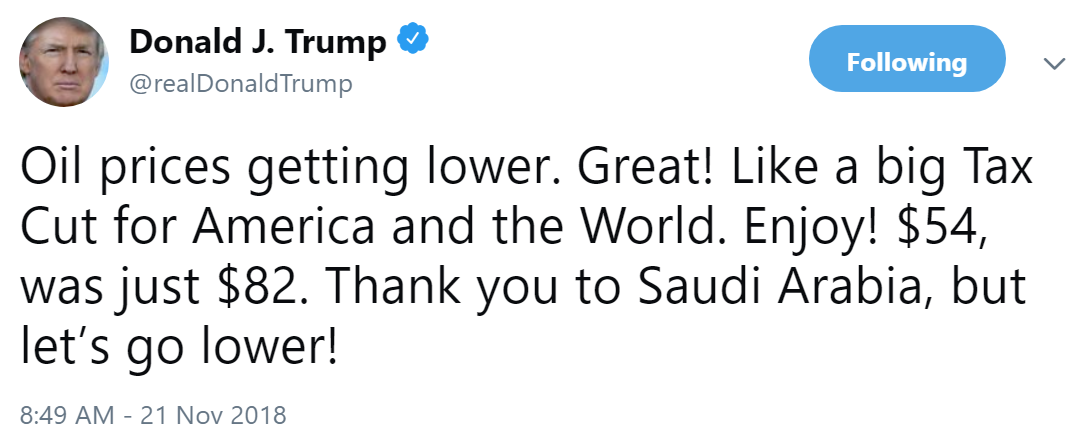
The endless oil match has been set and the pieces assembled. The supply/demand fundamental is the King of the chess board. All actions in the match are meant to protect or expose this piece, and the price of oil is determined off of it. A mere two months ago we were discussing how tight the oil market could get, after an expected loss in production. This quickly changed due to the Queen piece of the board, geopolitical issues. Geopolitical issues can move in any direction at any time, and can test all other fundamentals in the oil market. We last discussed geopolitical issues in our Check Back Soon blog series in July, but have lately seen a flurry of news involving two of the Rooks on the board, President Trump and Saudi Arabian Crown Prince Mohammad Bin Salman. After the suspected ordered murder of journalist Jamal Khashoggi, tensions have been high between the U.S. and the Kingdom. President Trump has not indicated any retribution towards the King, likely in an attempt to suppress oil prices. All the while, the U.S. has been issuing waivers to countries to use Iranian oil, which many previously believed would be cut off by sanctions. While there are many other back story Pawns at play here, the end result has been an increase in supply on the market versus what was expected.  In the days following the Khashoggi killing on October 2nd, oil has seen one of its’ quickest slumps ever, with WTI down 32% from over $72/bbl to $52/bbl (not to be confused with Trump mixing Brent and WTI in his tweet). At one point there were 12 straight days of falling prices. The match has turned in favor of President Trump and Americans seeking low oil prices.
Two months ago, analysts were saying that oil could go to $100/bbl. Now there are analysts saying that we could fall back in to the $40 range. Factors affecting the outlook of oil prices include: Federal Reserve interest rate hikes (which strengthen the dollar, lowering the relative price of oil), a continued trade war with China (which hurts consumption), and lastly whether or not OPEC will announce a new round of production cuts.  All of these factors are set to be decided on in the next few weeks. If we see the bearish outcomes of all these factors, prices could fall further. A bullish correction is also possible given the volatile nature of these fundamentals. It will also be important to watch how American producers will fare with profitability in the long run with prices falling. Aside from oil, we have not seen a significant impact on the natural gas market. The Permian region is still increasing its production of oil, and associated natural gas is currently near capacity, with additional oil and gas pipelines coming online in 2019. This growth will help ensure the US maintains the power to control energy markets.
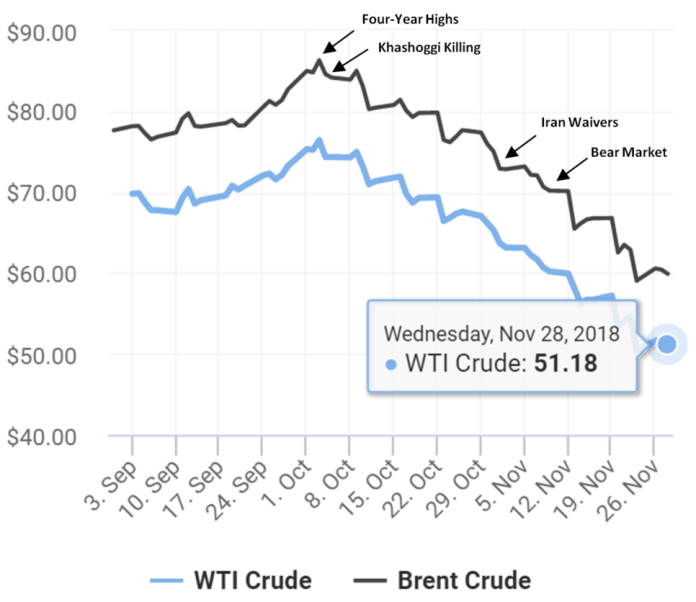
It is no secret that the price of oil has a huge impact on the world economy. However it is often understated how much of a rippling impact oil can have on many fronts in the energy market. It is not often that we discuss the oil market, but the recent 30% slump in prices was worthy of discussion today. The future impacts of this move are still speculative, but regardless we will continue to monitor the situation, and report on any implications this significant move may have for our clients.
Confidential: Choice Energy Services Retail, LP.

Check Back Soon: Oil Market Volatility

By: Chris Amstutz

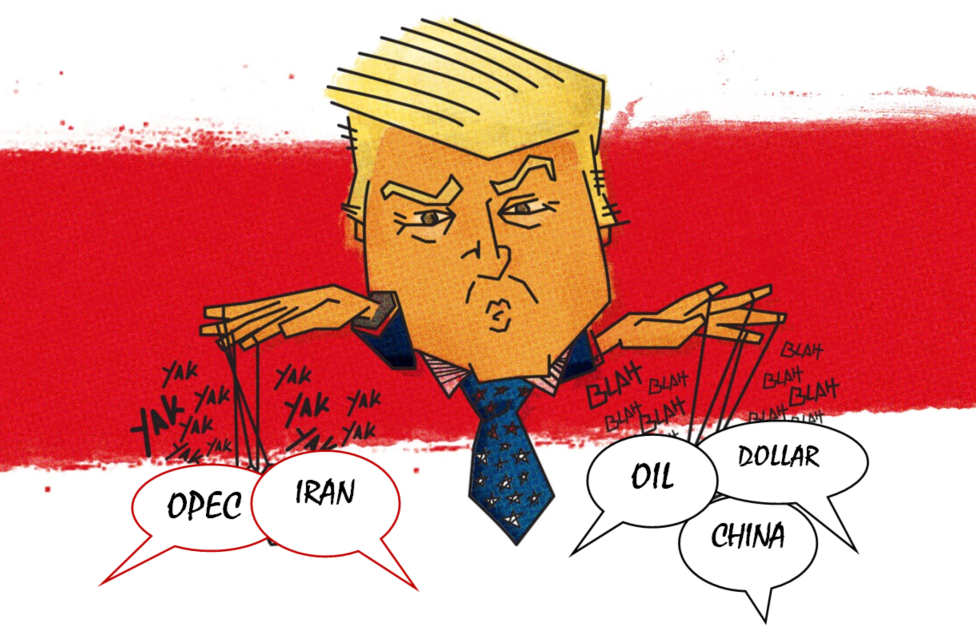
Many analysts in the energy industry try to make a living by attempting to forecast the next big macro shift in oil prices. The truth of the matter is that nobody can fully anticipate movements in oil prices, not in this geopolitical environment, not with Trump as our President. Just when an analyst thinks they have completed the puzzle, the global market influences scramble and add in more pieces. OPEC decisions, sanctions on Iran, and Permian oilfield growth are a few topics worth discussing for current events but even these influencers change daily. If you need more proof as to the fallibility of a predictive analyst, just know that we are coming up on the 10th anniversary of the “Peak Oil” scare. Many analysts predicted that by 2018 global oil production would be drastically cut to 50 million barrels/day, but instead we have increased global production by nearly 15% to 100 million barrels/day.  So where is oil going next, and how will energy prices be affected!? We won’t guess, but today we will start a multi-part blog series, briefly introducing the topics that keep oil market analysts on their toes.

Iran Deal Termination:

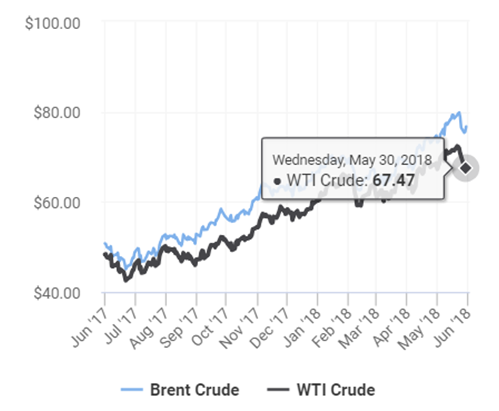
On May 8th President Trump announced that the US would be ending its’ involvement in the Iran deal, and reinstating the “heaviest” of economic sanctions on the nation. These sanctions will impact nearly every industry in Iran and will hit in August 2018. Since the Iran deal began in 2016, Iran has been able to increase their oil production from 2.9 to 3.8 million barrels per day (EIA). Almost half of this production growth is now expected to be lost. As a result of the news, WTI Crude prices pushed over the $70 mark.

OPEC Production Re-evaluation:

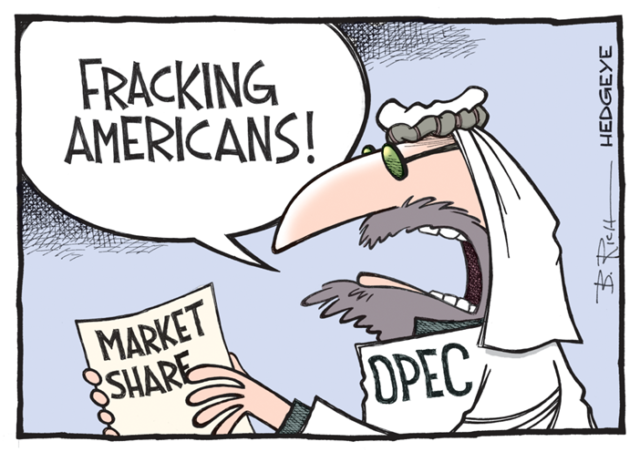
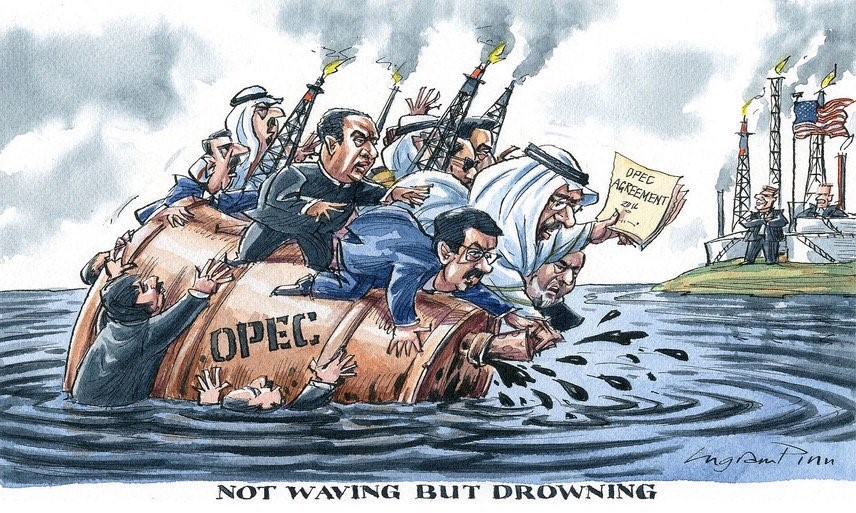
Since December 2017, OPEC has succeeded in lowering their collective production output. Consensus was that OPEC was re-balancing the market to reach a desired $70/bbl price. With the news on Iran, mixed with continued collapse in Venezuelan production, we are likely to see a shift in policy. This expectation has likely allowed Oil prices to come back down off their recent highs. OPEC cannot risk losing market share to growing American producers and this will likely put a lid on prices in the short run.

 American Production Growth:

We have seen huge growth from American oil producers in the last several months. The increasing price of oil is likely the cause, and confirms the market share fears that OPEC has with American fracking producers. We have seen the EIA’s estimates for 2018 production climb to 10.722 MMb/d,a 1.37 MMb/d increase over 2017. The projections for 2019 are even more impressive at 11.58 MMb/d. It is important to note that these are only projections and are certainly susceptible to a different puzzle of micro/macro influences, such as pipeline constraints from the Permian basin. If forecasts are proven true, this production growth should help offset any bullish news that arises from other influencers.

After touching on a few of these current events, you can see the complexity in the oil market puzzle. It is all too easy to remain on the fence when trying to decipher the outcome in commodity markets. Luckily, retroactively criticizing the bold “Peak Oil” predictors is only what we do for fun at Choice Energy Services! Our analysts often write about and discuss where they believe oil, natural gas and electricity market prices are heading. These opinions are based in facts and data that can be seen in our market intelligence reports. Whether you are looking for detailed analysis like the Bulls and Bears report, or whether you simply enjoy mediocre, political cartoon-oriented blog pieces, Choice Energy Services has you covered on the latest oil market fundamentals. Check back soon for the next news worthy installment of our Oil market blog series.


Did Trump Save Coal?

by Chris Amstutz / Matthew Mattingly

It was around this time last year that in the heat of the presidential campaign, we witnessed a full committal to the coal industry by Donald Trump. “A lot of people are going to be put back to work, a lot of coal miners are going back to work,” was stated by Donald Trump, both as the presidential nominee and later as POTUS. Fast forward to today, less than a year after Trump being in office, and coal is back as the number one fuel source for electricity generation in the United States. So did Trump keep his promise?  Here at Choice Energy Services we will take a break on the war on “fake news” and look at the facts behind coal’s revival.

For decades the domestic abundance of coal made it a profitable fuel source for electricity generation, but with the innovation of hydraulic fracturing for natural gas and realities of Obama-Era regulations on carbon emissions, the profits disappeared.  In 2016 many analysts were all ready to anoint natural gas as the new king of electricity generation in the United States. But natural gas’ reign as the leading fuel source didn’t last long. As of August 2017, Coal has reclaimed its’ place as the top electricity generating fuel source, and has been projected by the EIA to remain as such for the rest of 2017 and through 2018.

So does this mean we’re witnessing a Trump effect in real time!? To that we answer, no. It is true that some executive regulations have been halted and awareness for coal miners increased but the data has other explanations.  To put it simply, it’s all about the Benjamins. Utilities operate like the rest of us, ones that have the ability to switch from coal to natural gas will make their decision based on price. Just as a driver will always pick the gas station that is $0.10/gallon cheaper, utilities will make the conscious decision to generate electricity from the cheapest fuel source. For example, to start the summer the May 2017, Henry Hub natural gas spot prices was $3.22/MMBtu as compared to $2.25/MMBtu for Appalachian Coal. The result is that the EIA expects natural gas fired generation to fall from 34% of total generation in 2016 to 31% in 2017, while they expect coal fired generation to increase from 30% in 2016 to 32% in 2017. The percentage difference is being made up from 2017 decrease in demand for electricity and an increase in renewable generation.

While many see new life in the coal industry, the reality is that without drastic policy change, no amount of “Pittsburgh, not Paris” chants will divert the road to the grave of coal as an energy source. Carbon emission policies are certain to change with political parties, which make 30-40 year investments in coal fired power plants unlikely. A net loss of 8,992 MW of coal powered generation capacity is slated to come off the grid in the next 12 months, as opposed to a net addition of 20,966 MW of Natural Gas powered generation capacity. So while Trump has delayed the death of coal; the safer bet is on natural gas and renewables for generation growth in the United States.

Confidential: Choice Energy Services Retail, LP.